 Add to Chrome
 Add to Firefox
 Add to Edge
X-Foresight: A Joint Vision-Action Causal Forecasting Network via Predictive World Modeling
May 24, 2026
Physical world knowledge resides mainly in videos. Equipping Vision-Language-Action (VLA) models with such knowledge is fundamental for safe and generalizable planning. Predictive world modeling enables VLA to internalize physical dynamics and long-term causality by predicting future video from past observations. However, naive next-frame prediction faces two challenges: 1) unlike semantically distinct text tokens, video tokens are low-entropy and redundant, causing prediction to degenerate into trivial extrapolation. 2) world modeling poses a temporal dilemma: dense prediction captures instantaneous dynamics, but cannot efficiently model long-horizon causality. To learn world knowledge effectively, we introduce X-Foresight, a predictive world model integrated directly into the VLA architecture to jointly learn world modeling and real-time action control. At its core lies a long-horizon chunk-wise auto-regressive strategy that addresses both challenges: by predicting semantically distant chunks rather than adjacent frames, it escapes trivial extrapolation, while preserving dense intra-chunk frames for instantaneous dynamics and sparse inter-chunk transitions for long-term causality. A curriculum learning schedule progressively extends prediction horizons and stabilizes long-horizon training. To capture long-term causality effectively, we present temporal importance sampling, which concentrates supervision on safety-critical chunks identified by ego-motion and behavioral signals. We further delegate photorealistic synthesis to a diffusion-based multi-view renderer, improving photorealistic appearance. Comprehensive experiments demonstrate that X-Foresight significantly outperforms VLA baselines in planning performance while maintaining strong generative fidelity, establishing a robust paradigm for world-knowledge-driven autonomous systems.

CaLoRAify: Calorie Estimation with Visual-Text Pairing and LoRA-Driven Visual Language Models
Dec 13, 2024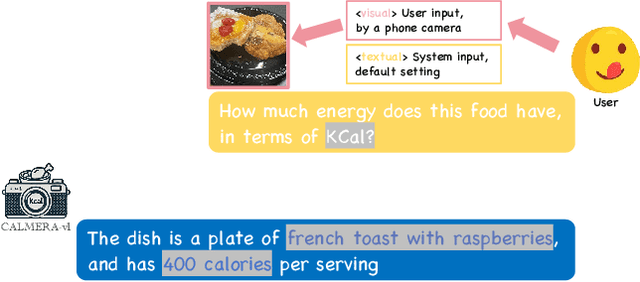
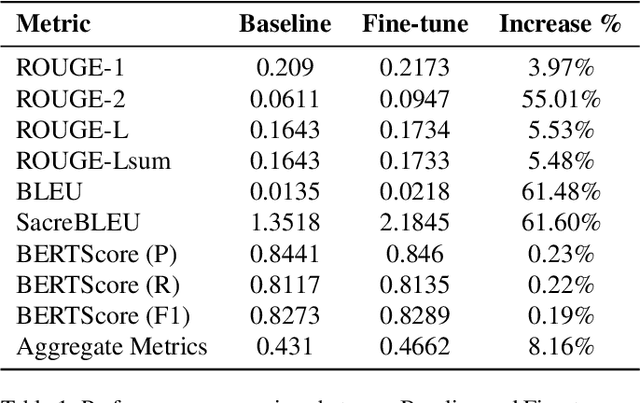
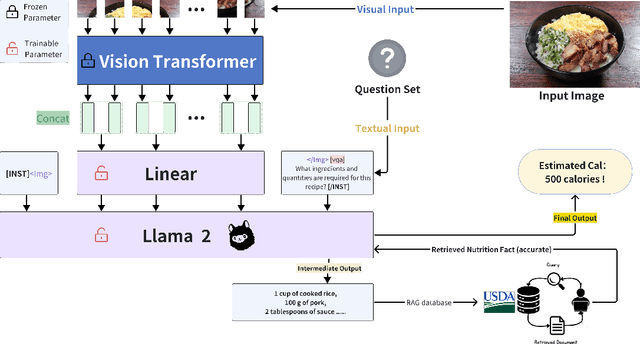
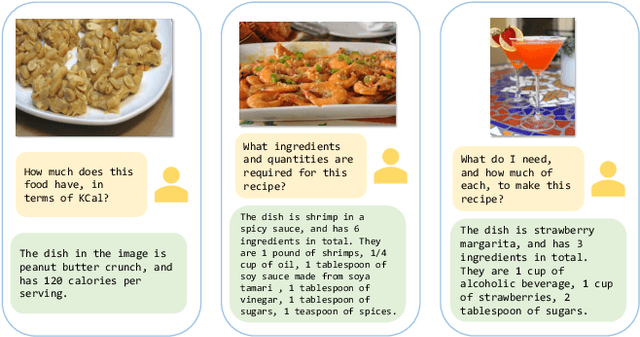
The obesity phenomenon, known as the heavy issue, is a leading cause of preventable chronic diseases worldwide. Traditional calorie estimation tools often rely on specific data formats or complex pipelines, limiting their practicality in real-world scenarios. Recently, vision-language models (VLMs) have excelled in understanding real-world contexts and enabling conversational interactions, making them ideal for downstream tasks such as ingredient analysis. However, applying VLMs to calorie estimation requires domain-specific data and alignment strategies. To this end, we curated CalData, a 330K image-text pair dataset tailored for ingredient recognition and calorie estimation, combining a large-scale recipe dataset with detailed nutritional instructions for robust vision-language training. Built upon this dataset, we present CaLoRAify, a novel VLM framework aligning ingredient recognition and calorie estimation via training with visual-text pairs. During inference, users only need a single monocular food image to estimate calories while retaining the flexibility of agent-based conversational interaction. With Low-rank Adaptation (LoRA) and Retrieve-augmented Generation (RAG) techniques, our system enhances the performance of foundational VLMs in the vertical domain of calorie estimation. Our code and data are fully open-sourced at https://github.com/KennyYao2001/16824-CaLORAify.
Clustered-patch Element Connection for Few-shot Learning
Apr 20, 2023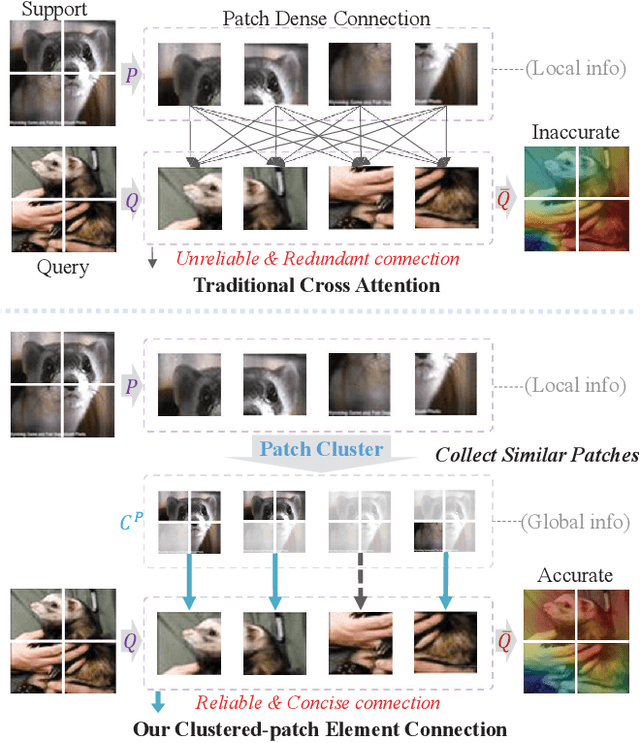
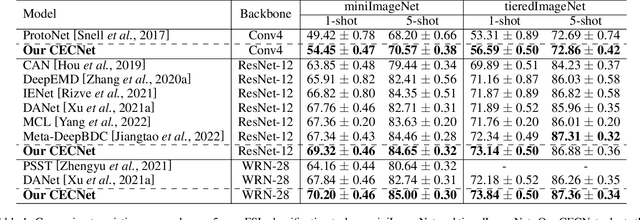
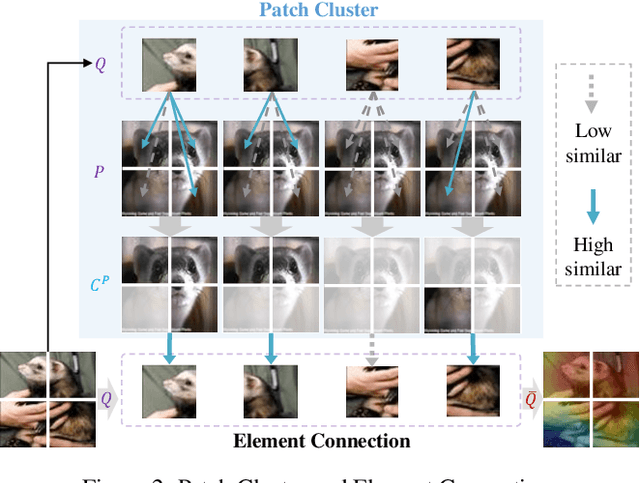
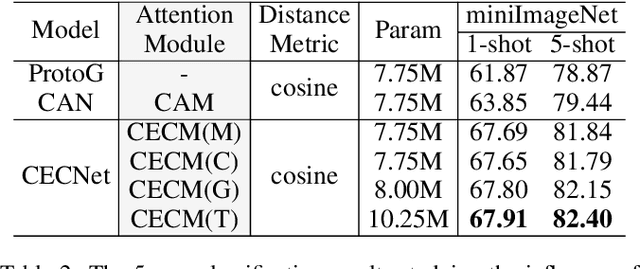
Weak feature representation problem has influenced the performance of few-shot classification task for a long time. To alleviate this problem, recent researchers build connections between support and query instances through embedding patch features to generate discriminative representations. However, we observe that there exists semantic mismatches (foreground/ background) among these local patches, because the location and size of the target object are not fixed. What is worse, these mismatches result in unreliable similarity confidences, and complex dense connection exacerbates the problem. According to this, we propose a novel Clustered-patch Element Connection (CEC) layer to correct the mismatch problem. The CEC layer leverages Patch Cluster and Element Connection operations to collect and establish reliable connections with high similarity patch features, respectively. Moreover, we propose a CECNet, including CEC layer based attention module and distance metric. The former is utilized to generate a more discriminative representation benefiting from the global clustered-patch features, and the latter is introduced to reliably measure the similarity between pair-features. Extensive experiments demonstrate that our CECNet outperforms the state-of-the-art methods on classification benchmark. Furthermore, our CEC approach can be extended into few-shot segmentation and detection tasks, which achieves competitive performances.